How to check if ChatGPT recommends your business
Does ChatGPT recommend your business? Ask what customers ask, with your city, in a clean chat, three times each. Then count the answers that name you.
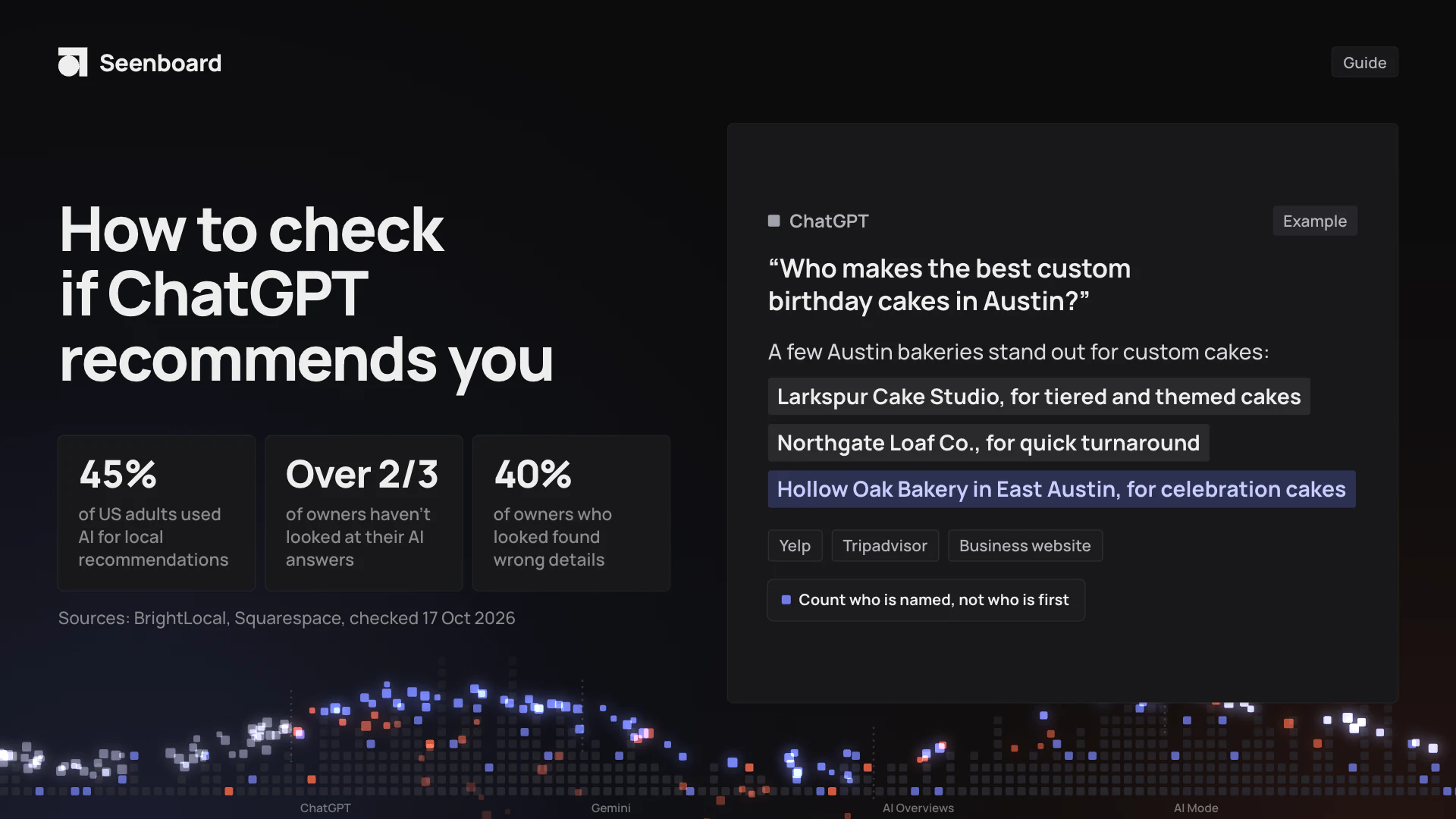
Ask ChatGPT the questions your customers ask, with your city in each, logged out or in a temporary chat set to Unpersonalized. Ask each one three times, because answers shift from run to run and day to day. Write down whether you were named, who was named instead, what was wrong and which sites were cited.
Ask ChatGPT what your customers would ask, with your city in every question, and count how often you are named. That is the whole check. The steps below keep it fair: a clean chat, a few runs of each question and a simple record of what came back.
Why check if ChatGPT recommends your business?
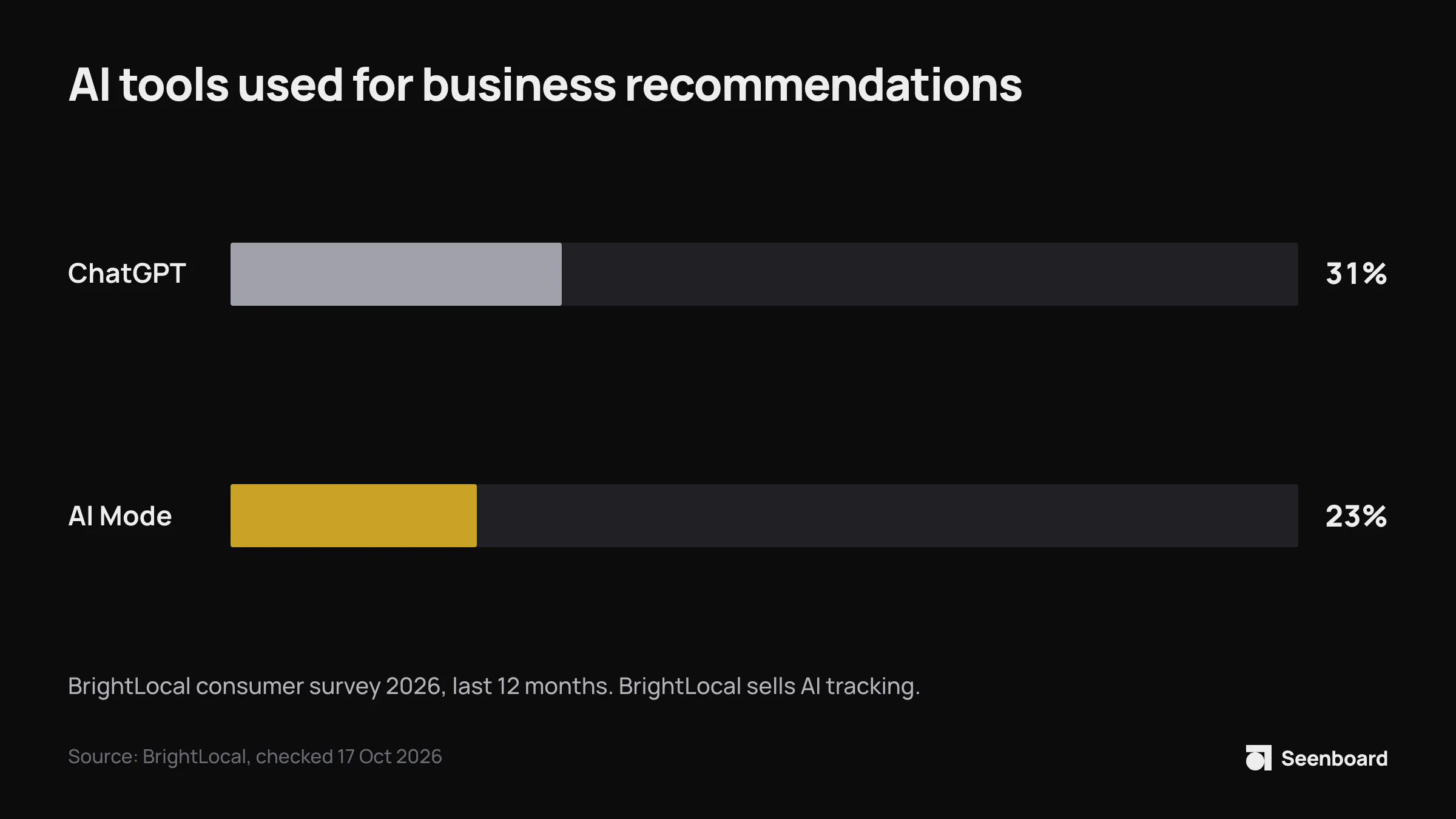
Because your customers already ask it. In a 2026 survey of US adults by BrightLocal, which sells local SEO and AI tracking tools, 45% had used ChatGPT or other AI tools for local business recommendations in the past year, making AI their third most used source of recommendations.1 ChatGPT was the most used AI tool, at 31% for business recommendations in the last 12 months, with Google's AI Mode next at 23%.2
Most owners have not looked yet. In an April 2026 survey of small business owners by Squarespace, which sells websites and an AI visibility tool, over two-thirds had not yet looked at how their business shows up in AI answers.3
Which questions should you ask ChatGPT?
Ask the way a customer types or talks, not the way you would write a keyword. "Plumber Leeds" is a search term. "Who can fix a leaking boiler in Leeds today?" is what someone asks ChatGPT.
Put your city, or your neighbourhood and city, in every question. OpenAI's own help page tells people to include their city, neighbourhood or postal code when local results show the wrong area, and says ChatGPT may estimate where you are from your IP address.5 You want the answer a customer in your town gets, not one shaped by wherever you happen to be sitting.
Write about 10 questions, spread across these kinds:
- Best-of: "What's the best bakery in East Austin?"
- Service: "Who makes custom birthday cakes in Austin?"
- Problem: "My dishwasher is leaking, who can come out today in Leeds?"
- Need: "Which dentists in Leeds see new patients on Saturdays?"
- Comparison: "Is [your business] or [a rival] better for wedding cakes in Austin?"
- Facts about you: "What are [your business]'s opening hours?" and "Does [your business] deliver?"
Keep your name out of the first four kinds: they test whether ChatGPT picks you. The last two test what it knows about you once someone asks. For wording, borrow from your customers: the phrases they use in reviews, calls, emails and booking forms.
How should you ask so the answers are fair?
- Log out, or use a temporary chat. Your own account may remember past chats about your business.6 A temporary chat set to Unpersonalized does not use memory, custom instructions or plugins; you choose that before the first message.6 If memory is on, a saved location can also change search results.5 A temporary chat also shows no ads.14 Outside one, you may see a labelled ad below an answer;14 an ad is not ChatGPT naming a business, so leave it out of your count.
- Start a new chat for every question, so one answer cannot steer the next.
- Ask each question three times, each in its own new chat. Answers change from run to run. In a January 2026 study by SparkToro and the AI tracking company Gumshoe, there was less than a 1 in 100 chance that ChatGPT or Google's AI would give the same list of brands in any two of 100 answers to the same question.4 SparkToro's Rand Fishkin calls these tools probability engines, built to give a new answer each time.4 The study's volunteers kept their usual settings,4 so some of that spread may come from personalisation. A clean chat varies too: when MaxAEO, which also sells AI tracking, re-ran software-buying questions in clean sessions within the same hour, ChatGPT's list of brands still differed in 7% of pairs of runs.8
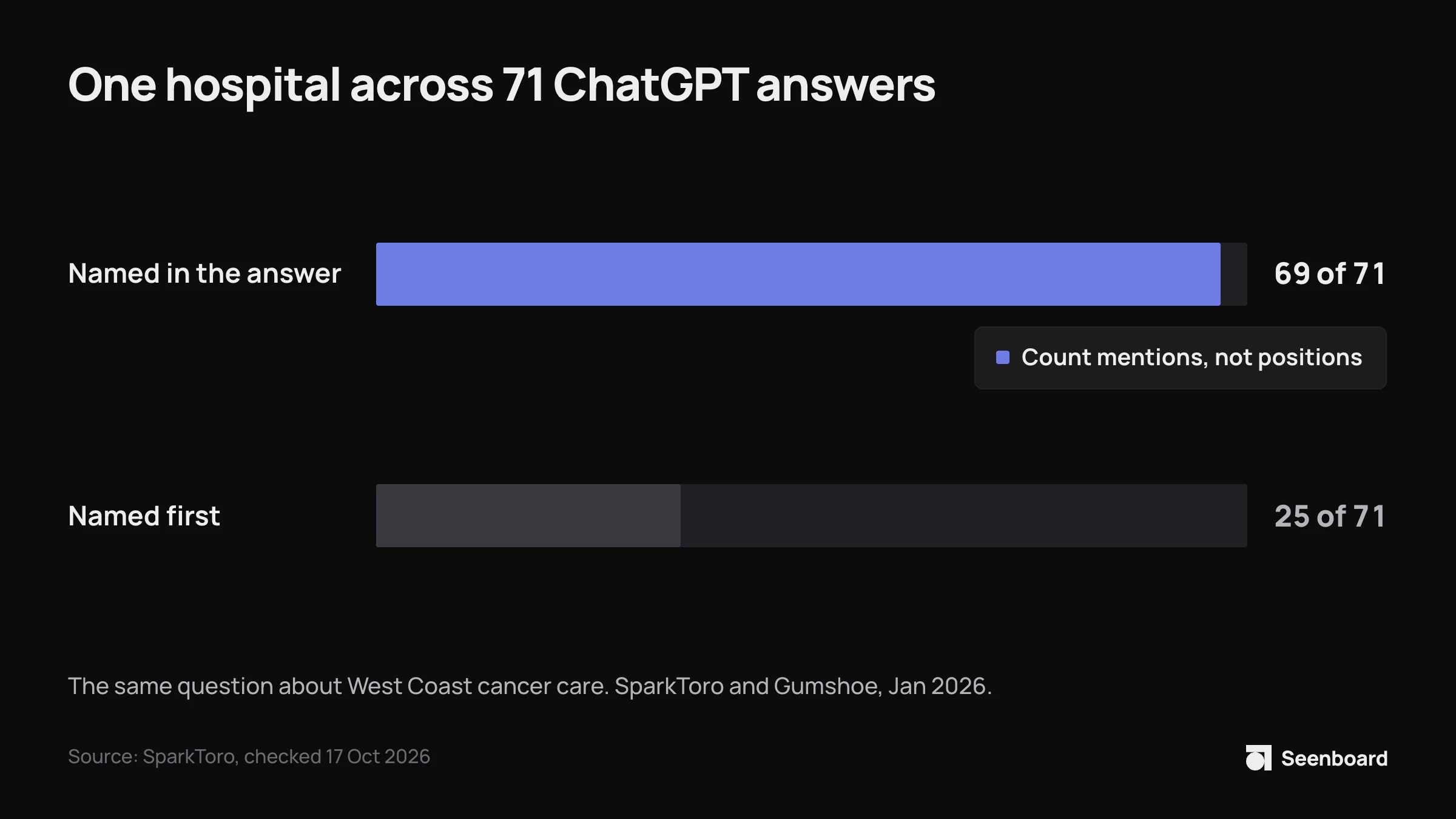
The useful part: being named is much steadier than being first. Across 71 ChatGPT answers to one question about West Coast cancer care, City of Hope was named in 69 but came first in only 25.4 So count how often you are named, and read little into your place in the list.
What should you write down?
One row per answer. A sheet like this example is enough:
| Question | Run | Named? | Named instead | Wrong details | Sites cited |
|---|---|---|---|---|---|
| Best bakery in East Austin | 1 | No | Rival A, Rival B | None | yelp.com, tripadvisor.com |
| Best bakery in East Austin | 2 | Yes | Rival A | Old opening hours | yelp.com, your website |
Four things matter:
- Named or not. Yes or no for each answer. Add the position if you like, but count the yes answers.
- Who is named instead. Every business named when you are not. The one that keeps coming up is the one to study.
- What is wrong. Hours, phone number, address, prices, services, the areas you cover, or an answer that says you have closed.
- Which sites are cited. The pages ChatGPT used for the answer. Note whether your own website is one of them.
Wrong details
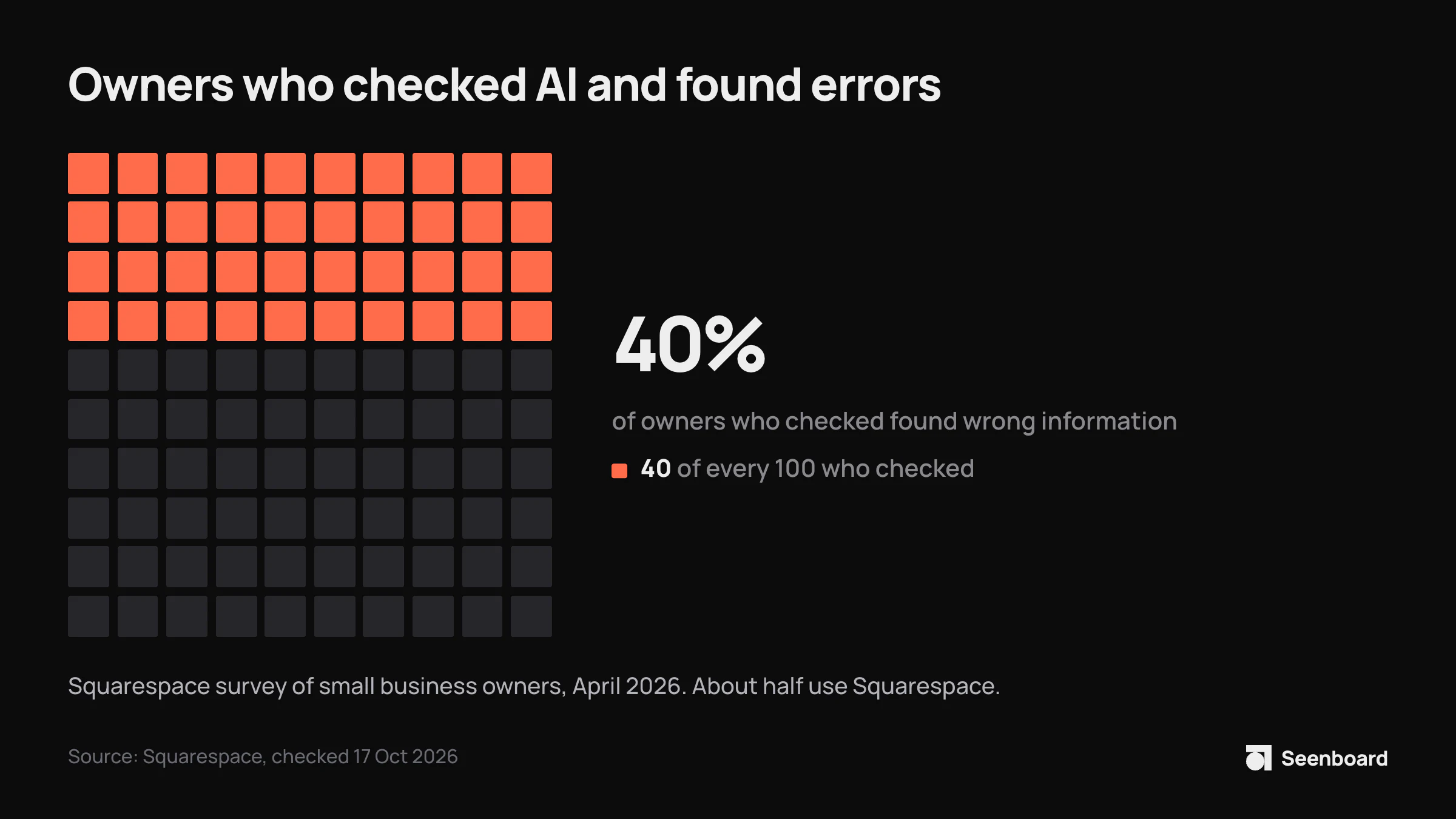
Expect some. In the Squarespace survey, 40% of owners who had checked how AI search shows their business had already found incorrect information.3 The fact questions are the quickest way to find it: ask for your hours, phone number and address, then compare each answer with what is true today.
Cited sites
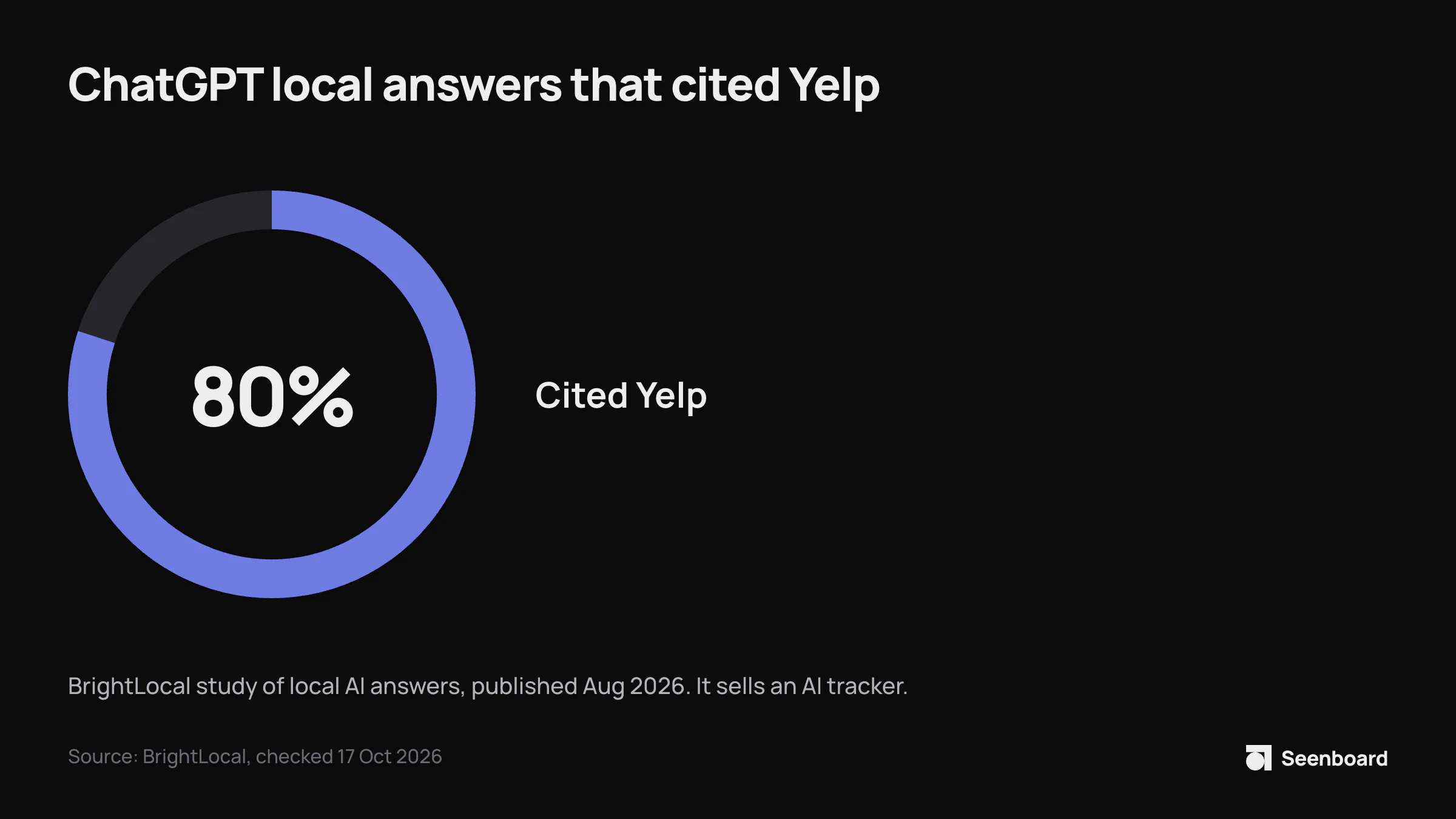
Select Sources under an answer, when it is shown, to see the pages ChatGPT used.5 For local questions, expect directories. In a study published in August 2026 by BrightLocal, which sells an AI tracker, Yelp was the most common source for ChatGPT and appeared in 80% of its answers, while Google's AI Overviews and AI Mode leaned on the Google Business Profile.7
When a detail is wrong, open the cited pages: if one of them shows the same mistake, that is the page to fix.
How do you read the results?
Ten questions asked three times gives you 30 answers. The number of answers that name you is your ChatGPT count for this month. Then look for patterns:
- Named for fact questions, not best-of questions. ChatGPT knows you but does not pick you yet. The businesses it picks instead, and the sites cited for them, show what it is reading.
- Named for some services, not others. Check whether the missing services have their own page on your site and come up in your reviews.
- The same wrong detail in several answers. Fix the source page before anything else.
- One rival everywhere. Compare their listings, reviews and pages with yours.
Do not read much into a swing of a few answers between months. Part of any change is chance,8 and across 30 answers chance alone can move the count by several. Trust a change that holds for two or three months.
ChatGPT is also only one AI. Google's AI Overviews and AI Mode lean on different sources from ChatGPT,7 so check them, and the Gemini app, separately: AI Overviews vs AI Mode vs Gemini explains how they differ.
How often should you check?
Once a month is enough for a hand check, plus after any big change: a new website, new hours, a move or a new service. Use the same questions each time so the months compare.
Do not react to a single bad day. In MaxAEO's daily tracking study of software-buying questions, ChatGPT's set of recommended brands changed from one day to the next for 18% of questions; across all the AIs it tracked, changes spiked after model updates and took days to settle.8 A count across many answers tells you more than any single screenshot.
When does a tool make sense?
A hand check costs time. Ten questions, three runs, is 30 chats for ChatGPT alone. Adding AI Overviews, AI Mode and Gemini makes 120. Done once a month, it is a snapshot: good for a first look, thin for spotting change.
A tool makes sense when you want answers checked every day, more questions than you can type, several services or locations, or rivals followed over time.
- Check what you already pay for. Local SEO suites and website builders are adding this. BrightLocal sells a Local AI Visibility Tracker for ChatGPT and Google's AIs,7 and Squarespace has built an AI Visibility tool, which checks ChatGPT and Gemini, into the Squarespace dashboard.13 If one of them already runs your listings or website, start there.
- Compare the options. See the best AI visibility tools for small businesses, and how Seenboard compares with Peec AI if you have looked at Peec AI.
- See where you stand today. Our free check takes your business and city and shows whether ChatGPT and Google's AI recommend you, who they pick instead and what they get wrong. Free, 2 minutes, no card,9 and no account needed.12
- Follow it over time. Seenboard's free week asks ChatGPT, Gemini, AI Overviews and AI Mode 25 questions written for your business, every day.1116 It lasts 7 days, with everything included and no card.10
What should you do if ChatGPT leaves you out or gets you wrong?
Start with the pages it cites. Correct your Yelp listing and Google Business Profile, make sure your website states your hours, services and the areas you cover in plain text, and ask every customer for an honest Google review in their own words. Google's rules forbid asking only happy customers for reviews, or asking for specific content in them.15
Check that your website lets OpenAI's search crawler in: OpenAI says a site must allow OAI-SearchBot to be eligible for ChatGPT's search results.5
Wondering whether schema markup or an llms.txt file would help? Does schema or llms.txt help you show up in AI answers? looks at the evidence, and AI local search statistics for 2026 has the wider numbers. Then ask the same questions again next month and compare the counts.
FAQ
Does ChatGPT give everyone the same answer?
No. In SparkToro and Gumshoe's test, where volunteers kept their usual settings, there was less than a 1 in 100 chance that ChatGPT gave the same list of brands in any two of 100 answers to the same question. A clean chat still varies, and memory, custom instructions and location also play a part, so check logged out or in an Unpersonalized temporary chat and ask each question more than once.
Should I check in my own ChatGPT account?
Better not. Log out, or start a temporary chat and choose Unpersonalized before the first message, so your past chats and memory do not shape the answer.
How many times should I ask each question?
At least three times, each in a new chat. Count how many answers name you rather than trusting any single one.
Why does ChatGPT show the wrong hours for my business?
It may be repeating a page that has them wrong. Open Sources under the answer, when shown; if a cited page, often a directory listing such as Yelp, has the same mistake, correct it there. If none does, make sure your website and listings state your hours plainly.
If ChatGPT recommends me, does Google's AI too?
Not necessarily. In BrightLocal's study, ChatGPT leaned on Yelp while Google's AI Overviews and AI Mode leaned on the Google Business Profile. Check each one.
Can I just ask ChatGPT if it recommends my business?
Not usefully. Once your name is in the question, the answer shows what ChatGPT knows about you, not whether it would pick you for a customer. Ask what a customer would ask, without your name, and see if you come up.
Sources
Accessed
- BrightLocal, Local Consumer Review Survey 2026. Vendor-authored.
- BrightLocal, Nearly half of consumers are asking AI for business recommendations. Vendor-authored.
- Squarespace, AI Visibility: a guide to AI search for business owners. Vendor-authored.
- SparkToro, AIs are highly inconsistent when recommending brands or products. Vendor-authored.
- OpenAI, Searching the web with ChatGPT.
- OpenAI, Temporary chat in ChatGPT.
- BrightLocal, Where to get local citations for AI search. Vendor-authored.
- MaxAEO, How often do AI answers change?. Vendor-authored.
- Seenboard, Free check.
- Seenboard, The free week.
- Seenboard, What the free week includes.
- Seenboard, Free check without an account.
- Squarespace, AI Visibility.
- OpenAI, Ads in ChatGPT.
- Google, Prohibited and restricted content.
- Seenboard, Which AIs we check.
Read next
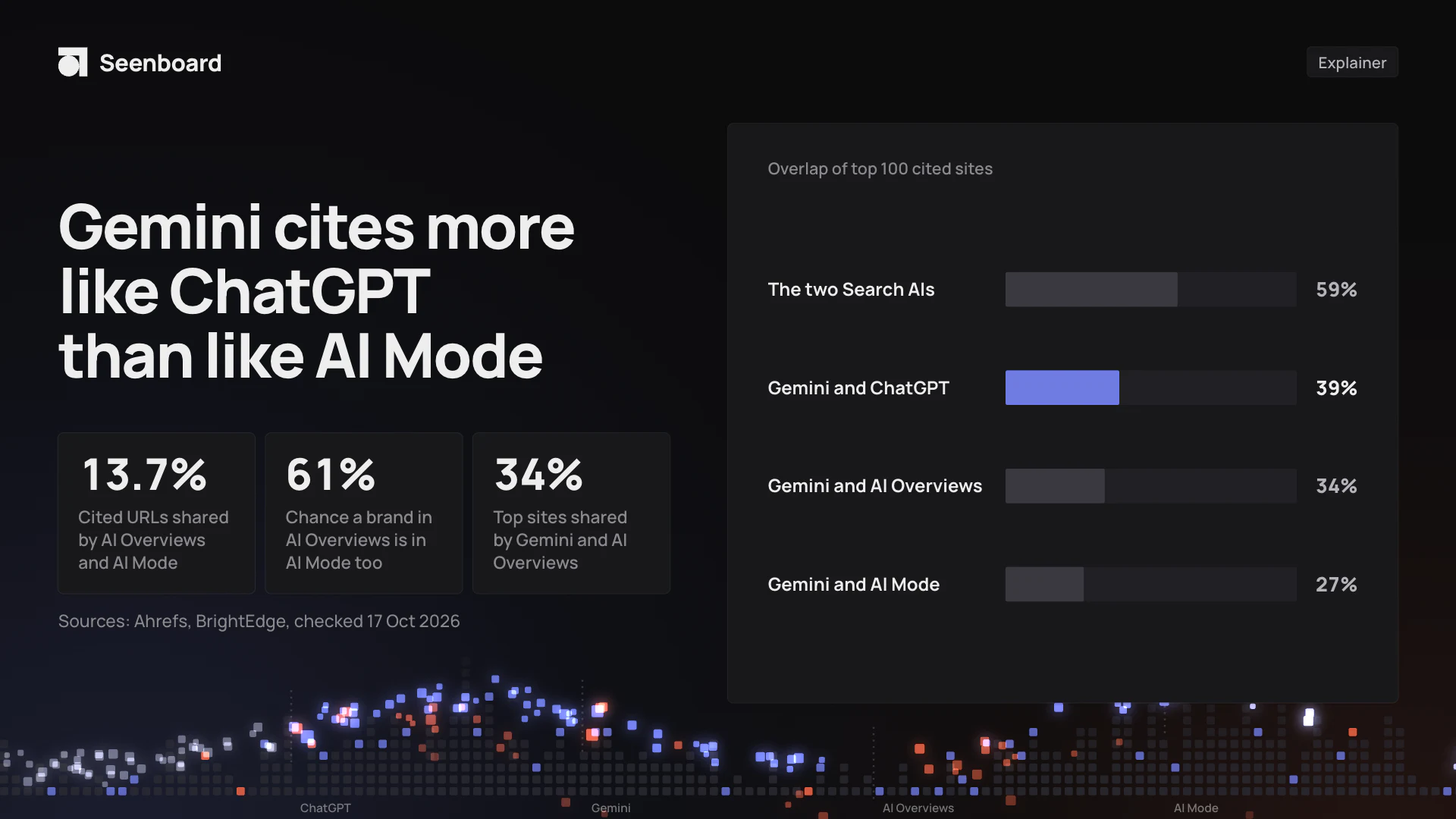
AI Overviews vs AI Mode vs Gemini for small businesses
One company, three AIs. They often name the same brands but mostly cite different pages.
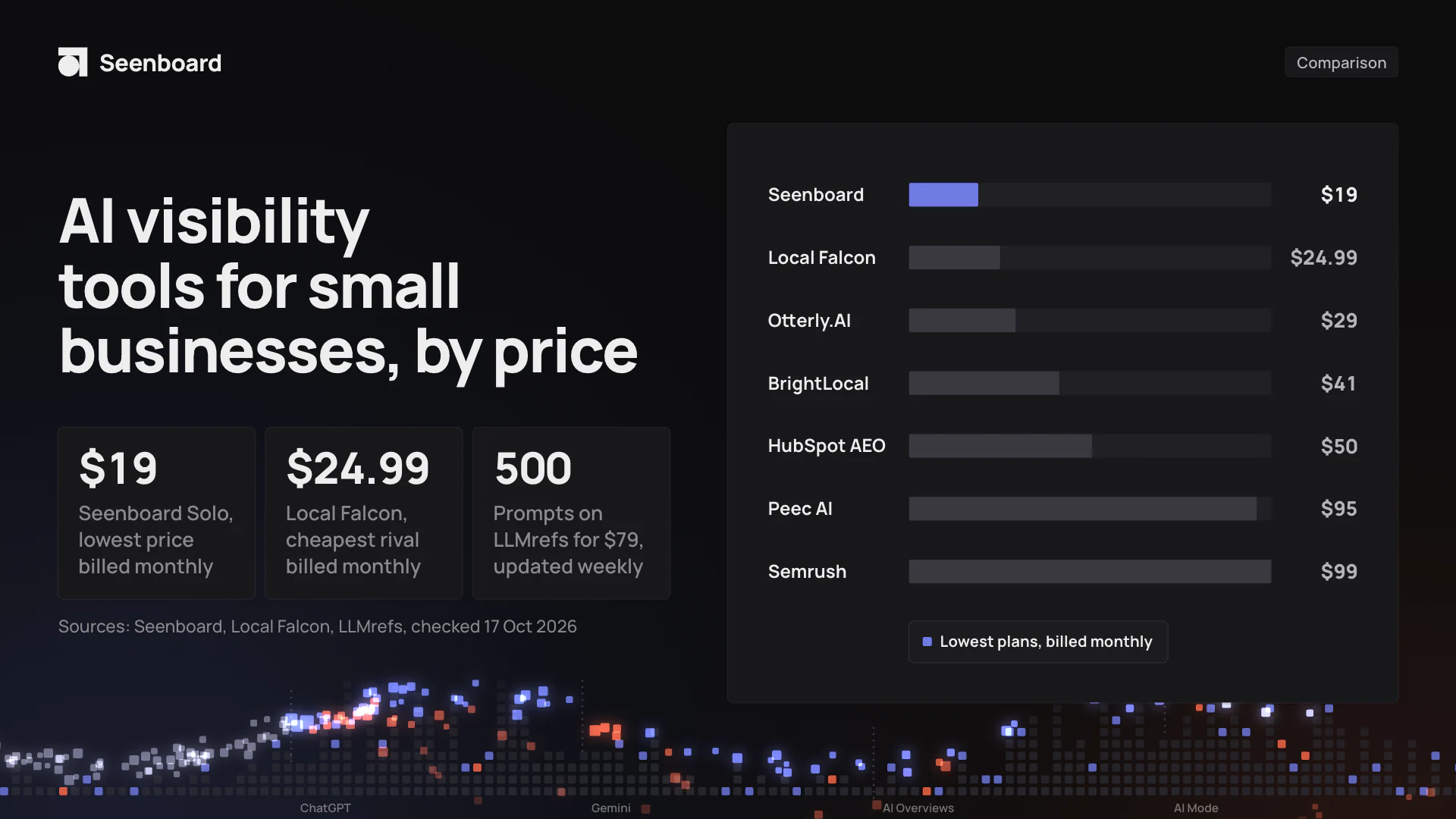
The best AI visibility tools for small businesses in 2026, by price
What the lowest plan of each tool costs and includes, who it suits, and where each one beats the others.
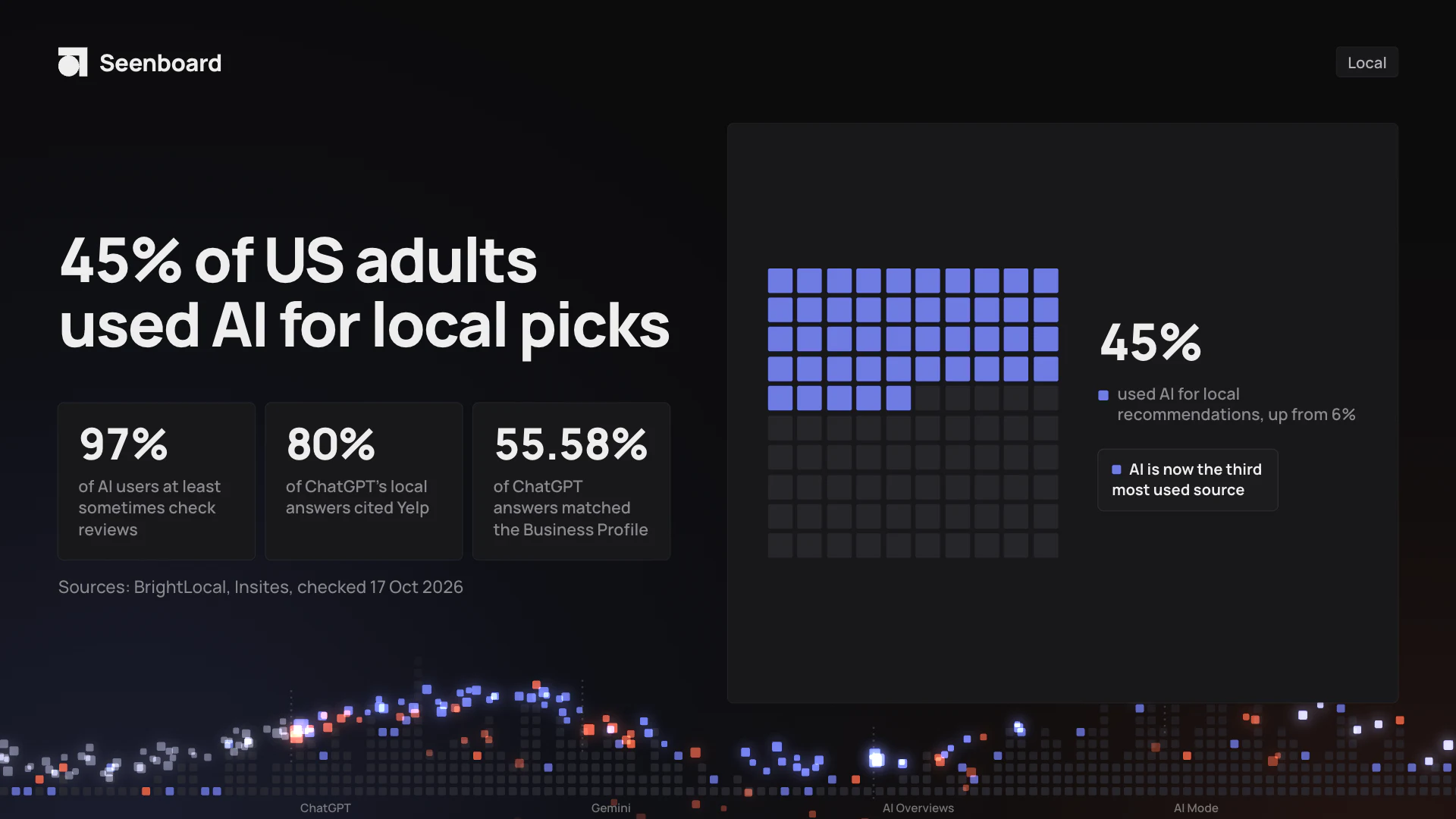
AI local search statistics 2026: 45% of US adults used AI for picks
The 2026 numbers on AI and local search, each from the publisher's own page, with its date and sample size.